Tower clock
Weights pull, a pendulum counts along: this is how a clock movement built without electricity works. Try it out, gear by gear.
How much time do you have?
The station has nine chapters. You do not have to see everything. Pick the route that suits your time and your curiosity.
- 3MinutesA quick lookThe movement on video, then as a 3D model in your hands.Chapter 01
- 15MinutesTinker yourselfWind the clock, unhook the pendulum and assemble the movement yourself.Chapters 02 and 03
- 10MinutesRead the storiesWho was Weule, and what does the house tell us where the clock stands?Chapters 05 to 08
Watch it at work
These recordings show the movement in motion: the pendulum, the gears, the teeth. Turn the sound on and listen.
The pendulum swings, and the gears turn inside the iron frame. This is how the clock still runs today.
A wheel with long brass teeth, with the rope drum beside it. With every swing of the pendulum, it jumps on by one tooth.
The videos only load when you scroll here. The sound applies to the video you switch on.
Turn the real movement
The clock movement as a 3D model, calculated from many photos. Drag with a mouse or finger to turn it, and look at the wheel train, rope drums and pendulum from every side.
The model is a scan. Small gaps and blurring come from the scan, not from the movement.
 Loads only when you start
How does it run without electricity?
This clock movement was built to run without electricity. Here it is a clock to try out: drag the yellow crank in a circle, watch the escapement in slow motion, take the pendulum off and move the bob. Five small tasks show you how the clock ticks.
Swipe the drawing sideways to see everything.
The drawing shows the principle. Sizes, gears and speed are simplified, and the pendulum adjustment is exaggerated. In the model, the weights last for a day and a half.
- Crank the clock until the weights are at the top.
- Watch the escapement in slow motion.
- Move the bob until the clock is off by more than a minute a day.
- Take the pendulum off and see what happens.
- Fast-forward the time until the weights are at the bottom.
Well done! You now know every move on this clock. Next, watch the real movement on video or build a clock movement of your own.
To the video of the real clock Build your own clock movementWhy two drums?
The movement has two rope drums. One drives the going train, which moves the hands. The other drives the striking train, which strikes the hours. Each has its own weight. When one has run down, the clock stops or falls silent.
What is a going train?
The going train is the part that counts the time and moves the hands.
What is a striking train?
The striking train triggers the bell strokes. According to the 2009 newspaper, the clock strikes the half hour and the full hour.
What is the escapement?
The escapement is the mechanism that slows the wheel train and releases only one step at a time, in the beat of the pendulum. The ticking you hear comes from there.
Who wound it?
The weights were wound back up regularly with the hand crank, and in 2009 still by hand. The master clockmaker who got the movement going then found hardly any wear. Even the brass bearings were still good.
Who took this on in 1875
We don't know yet. If you have memories or documents, please get in touch with us (see the very bottom).
Build your clock movement
The parts tray holds the parts of a tower clock movement. Drag them to their slots in the frame, or tap a part first and then a slot. Build the power chain from the weight to the dial. Two parts do not belong in this clock. How fast and how accurately can you do it?
Choose a part and place it in the frame. The yellow numbers show the slots. Tap a slot to read what is needed there.
Swipe the frame sideways to see all six slots.
The parts tray eight parts are ready, six belong in the clock
Your clock movement keeps time.
Now try something: click an installed part to take it out. The clock shows you straight away what happens then. Without the escapement, the movement races off. Without the pendulum, the beat is missing.
What does the frame say?
The iron frame carries the maker's name, I. F. Weule, and the place, Bockenem, with the year 1875. Tap the dots in the photo to get to know the parts of the movement.
Tap a dot.
We do not yet know what the numbers 37 and 39 stand for. Perhaps you know the answer?
One clock, many years
The clock and the bell belong together. Both hung on the Amtshaus opposite the museum. As you scroll, the wheel keeps turning. Here is what we know for sure.
- 1686The bell
A bell from Waddens comes to Ovelgönne
The consistory allows it to be set up for a striking clock and used as a prayer bell. Later it is called the “Poor Sinners’ Bell”.
- 1871The bell
Recast in Hildesheim
The bell has a deep crack. It is recast, weighing 240 pounds, with the inscription “Hora ruit, verbum Dei manebit”: The hour runs out, the word of God will remain.
- 1875The clock
The clock movement is made
Two sources give the year: the cast plate “BOCKENEM. 1875” on the frame and a newspaper report from 2009. Weule’s delivery list shows two clocks for Ovelgönne: one for the Amtshaus, one for the railway station. Which movement belongs to which entry, we are still finding out.
- 1959The bell
The bell moves to the church
On 21 January the gable of the old Amtshaus is falling into disrepair. The bell is taken down and moved to the church.

The gable in 1959. - 2009The clock
Running again, by hand
In January a master clockmaker gets the clock running again. He finds hardly any wear. After that it is wound by hand and strikes the half hour and the full hour.
- 2022The clock
Its condition is checked
Experts inspect the clock and assess what is needed to keep it running for good.
- 2026The clock
The clock gets electric power
Hand winding is a thing of the past. Who carried out the conversion and what remained of the original movement, we will add here as soon as the documents are available.
Who was Weule?
The cast plate names Weule in Bockenem. Tower clocks went from there to many places, including Ovelgönne. We know the company history from the chronicle of the Tower Clock Museum Bockenem. Move along the ruler.
On 20 October Weule opens a small clock shop in Bockenem. He sells pocket watches and Black Forest clocks and repairs clocks.
- On 20 October Weule opens a small clock shop in Bockenem. He sells pocket watches and Black Forest clocks and repairs clocks.
- On 9 April a great fire in Bockenem destroys 240 of 330 houses, including Weule's workshop. He rebuilds and wants to make only large clocks from now on, mainly tower clocks.
- The first tower clock goes to the Marktkirche in Goslar (ordered 1848). Building takes eight months, the price is 475 thalers.
- First clock with weekly winding, for St. Petri in Buxtehude.
- A factory is built at the Steintor.
- The movement for Ovelgönne bears the cast plate “BOCKENEM. 1875”.
- The next generation takes over. By then around 600 movements have been delivered, and 20 people work in the business.
- The company begins bell founding.
- Around 1890, 53 people build about 150 clock installations a year. As early as 1886 the total came to 1,150 movements delivered.
- Around 1900 the first Weule clocks get electric winding.
- As a replacement for bronze bells, Weule casts hard cast-iron bells (Klanggussglocken). From 1918 together with the Ulrich brothers of Apolda, after the Second World War on its own.
- The company has 100 employees, plus 15 French and 30 Russian prisoners.
- The company goes bankrupt. The site is demolished from 1979.
- In December the Tower Clock and Local History Museum Bockenem is founded. It preserves Weule clocks to this day.
Indispensably necessary for the preservation of the clock is the use of a good oil, free of acid and not gumming.
J. F. Weule, Anleitung zur Behandlung von Thurm- und Hof-Uhren (translated)

Weule clocks on the road
From Bockenem, clocks went to many cities and countries. The movement in Ovelgönne is one of many. Here is a small selection.
The world as seen from Bockenem. Tap a dot or choose “Germany”.
- 1849GoslarMarktkirche. The order came in 1848, and it was built over eight months.
- 1858BuxtehudeSt. Petri. The first Weule clock with weekly winding.
- 1879SydneyWorld Exhibition. Weule sends four movements to Australia.
- 1895HamburgThe town hall gets a tower clock from Bockenem.
- 1908GreifswaldCathedral of St. Nikolai. The clock was restored in 2000.
- 1909Tsingtau, ChinaChrist Church. In 1993 an electric clock from China replaced the movement.
- 1929ButzbachMarkuskirche. Since 2021 the clock has stood in the museum in Bockenem.
- 1936BerlinA carillon for the Olympic Games.
- 1940Bariloche, ArgentinaThe Centro Cívico in the Andes gets a Weule clock.
Iron
The frame is cast iron. For this Weule had its own iron and metal foundry.
Brass
The gears are made of brass. They were turned and filed in the machine workshop.
Wood
The stand is joined from wood, made in a joinery with powered machinery.
Fine tuning
Last came the regulating room: here a clock was set so that it keeps exact time.
A tower clock is not made by one pair of hands. The workshops come from the company site as it was around 1956.
More Weule clocks can be seen at the Tower Clock and Local History Museum Bockenem on the market square. It is open on weekend afternoons, and admission is free. Check the museum's website before you visit. When the company went bankrupt, all its records were destroyed, so little material has survived.
What does electricity change?
In the past, hands pulled the weights up. In 2026 the clock gets electric power. The craftsmanship behind it stays: the iron, brass and wood date from back then. Switch and compare.

Weights and hand crank
A crank pulled the weights up, as late as 2009 by hand. After that the clock ran until the weights were down.
So someone had to come regularly, crank and check. Without these people the clock stood still.
Electric power for the old clock
Since 2026, electric power does the lifting. The clock no longer needs to be cranked.
- Who converted the clock, and when exactly?
- What stayed unchanged on the original movement?
- Who sets and maintains the clock today?
Where is the clock?
The movement is in the house opposite the museum, the former district court building. It has seen a court, a school and many years. Here you can find out what we know about the house.
The house is now a private house. Please view it from the street and respect the privacy of the people who live there. You can only see the clock movement itself on action days. In the museum, a media station shows you what it looks like there.
Look closely
The gable holds many details that are easy to miss in passing. Tap the dots in the photo and discover them: the small roof turret, the dial and the irons that form a year.
Tap a dot in the photo.

Over 250 years in fast forward
Move the slider or tap a year. The text tells you what happened in the house at each point.
A courthouse is built

The court and the house opposite
The house with the clock is regarded as an exemplary district court building. Opposite stands the museum. It was built in 1773, only two years after the courthouse, as a manor house by the lawyer and district court beadle Rumpf. A beadle was an officer of the court. Whether Rumpf crossed the street every day, we do not know. But the closeness to the court is striking.
What are wall anchors?
Wall anchors are iron clamps that hold the walls and beams of a house together. In the past they were often shaped into decorative forms or numbers. This house shows the year it was built on its gable for all to see.
What is a roof turret?
A roof turret is a small tower that sits directly on the roof ridge. Here it carries the dial and has room for a bell.
What did the house look like in the past?
We do not know exactly yet. Do you have old photos or memories? Write to us below, we would love to hear from you.
Did you go to school here, work at the nurse station or live here?
From 1880 to 1951 the house was a school, for over 70 years. Anyone who learned here knows more than any archive. Tell us your memory of the house, the clock or the bell. We ask before anything is published.
Experience the clock live
The movement stands in a private house and can only be seen on action days. If in doubt, ask us first. In the museum, a media station also shows you what it looks like there.
Loading dates ...
The museum is open on Sundays from 14:00 to 18:00.
What do you think?
Who had to make sure this clock never stopped?
Someone had to crank the weights up at regular intervals, still by hand in 2009. Who took this on in 1875, we do not yet know.
What changes when a clock no longer has to be wound?
The clock no longer stops when nobody turns the crank. What else changes, we will tell you here as soon as we have spoken with those involved.
Help us understand the clock
There is a lot we do not yet know about this clock. Perhaps you do. We welcome every hint, even small ones, and we ask first before we publish anything.
What you take with you
Here you can see what you have already done in this station. Each line takes you straight to the rest.
None of this is stored. It only counts while this page stays open.
More digital stations
 Digital stationWolfgang HeimbachA Baroque painter from Ovelgönne. Deaf, widely travelled and long forgotten.
 Digital stationThe Zedelius SistersTwo women writers from Ovelgönne, with books and letters.
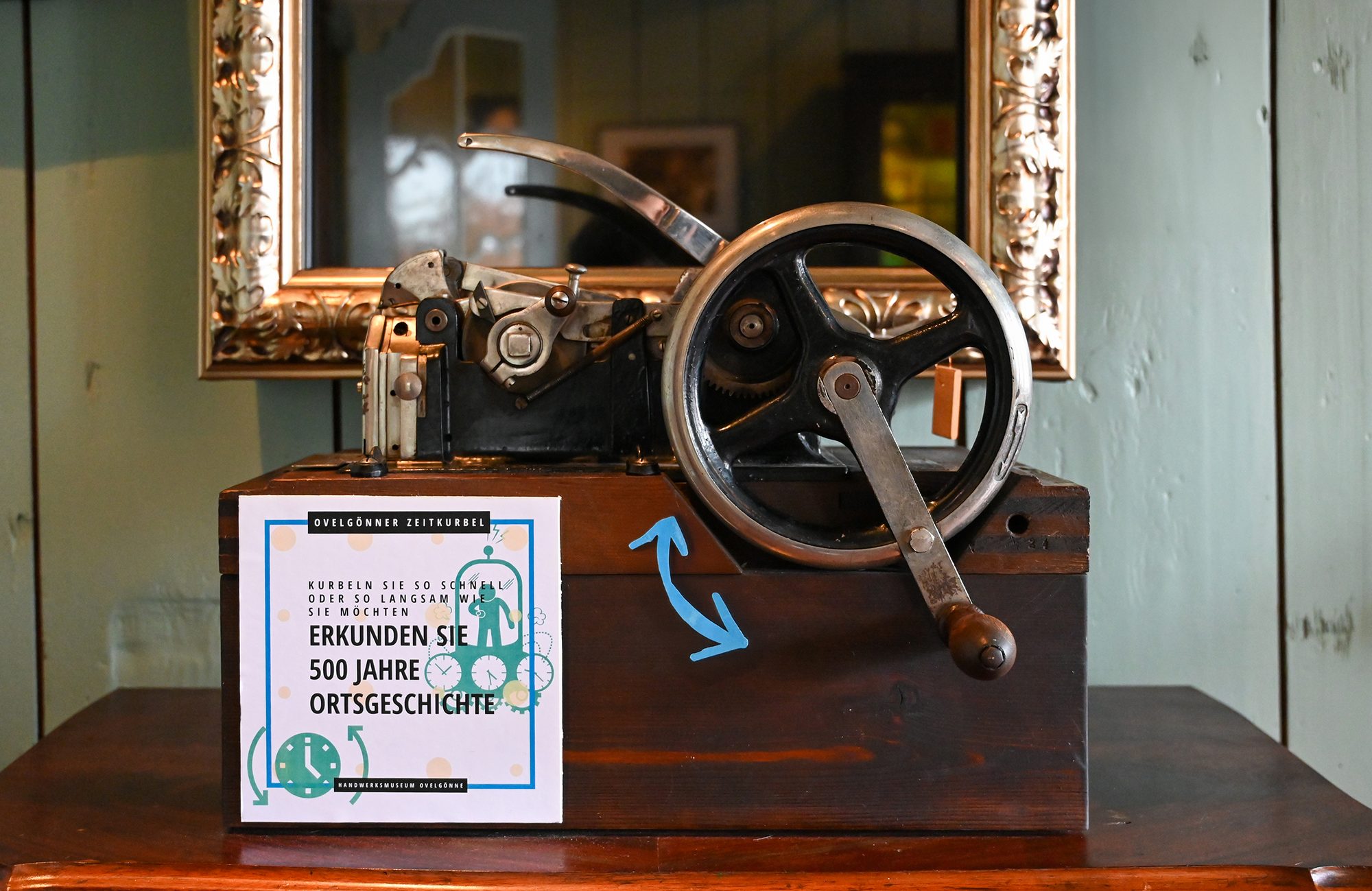 Digital stationThe Time CrankPhotos from Ovelgönne, turned through time with a crank.
 Digital GuideExhibit Guide with gamesNine exhibits, nine hands-on stories: knead dough, forge hot metal, weigh sacks.
 InteractiveLight Refraction SimulatorDrag the lamp, the water globe and the workpiece and see how a glass flask focuses light.
Sources and picture credits
All statements on this page are based on the following sources and on the clock itself.
- The clock movement: cast plates “I. F. WEULE.” and “BOCKENEM. 1875”, inscriptions “J.F.W. 39” and “J.F.W. 37”, two-drum movement, hand crank and pendulum, examined on the object. Photos: HMO A. Džaferagić 2026. Sound recording of the movement: HMO 2026.
- The Weule company: Tower Clock and Local History Museum Bockenem, Chronicle of the Weule company, the page on the factory grounds and the pages on the clocks in Tsingtau and Butzbach (retrieved in November 2026). The texts and photos on that site are protected by copyright, so we give the data in our own words. In addition: Wikipedia, article “J. F. Weule” (founding of the museum in 1970 and the clocks in Hamburg, Greifswald, Berlin and Bariloche). We also draw on information from the Tower Clock and Local History Museum Bockenem by e-mail (November 2026) on the early years of the company, the Klanggussglocken and the entry for Ovelgönne in the delivery list. Where the sources differ, we follow the Chronicle.
- Instructions for the care of tower and yard clocks (Anleitung zur Behandlung von Thurm- und Hof-Uhren): J. F. Weule, Bockenem, after 1881. Quotation and engraving of the factory, public domain, Wikimedia Commons (“Anleitung zur Wartung von Weule-Uhren”).
- The clock in 2009: Nordwest-Zeitung of 16 January 2009, “Uhr lässt Herz höher schlagen” (“The clock makes hearts beat faster”) (Torsten Wewer). We take only facts from it and do not quote it.
- The bell: “Die Arme-Sünder-Glocke” (“The Poor Sinners’ Bell”), archive of Michael Folter, after Walter Folter and Dieter Bolte, volume I.
- The house: Lower Saxony State Office for the Preservation of Monuments, Denkmalatlas Niedersachsen, entry “Landgericht”, object ID 201f2168-2ecd-4caa-a0db-0ee3ad4f9b72, licence CC BY-SA 4.0 (retrieved in November 2026); information from the museum on current use.
- Videos: Recordings by the Handwerksmuseum Ovelgönne, 2026.
- Other pictures: Engraving of the factory, public domain, Wikimedia Commons (see above). Photos of the house (gable with “1771”, roof turret, gable 1959): Handwerksmuseum Ovelgönne, individual credits to follow with the new photographs.
- 3D model of the clock movement: Photogrammetry from photos by Arman Džaferagić, computed with RealityScan, 2026.
- Electrification 2026: Information from the museum. Details to follow.