Digital station

Wolfgang Heimbach

A Baroque painter from Ovelgönne. Deaf, widely traveled and long forgotten. He painted for princes, kings and a pope.

We do not own any originals of his paintings. That is why we show what remains of him: his trail.

The painter

Who was Wolfgang Heimbach?

He is regarded as one of the most important northern German painters of the 17th century. Little is known about his life, and his work was long forgotten. Here is what we know for sure.

Lifespanabout 66 years

Thirty Years’ War, 1618 to 1648

  1. 1613Birthin Ovelgönne
  2. approx. 1630TrainingNetherlands
  3. from 1644ItalyNaples, Rome
  4. 1652Returnto Oldenburg
  5. approx. 1653Denmarkat court
  6. from 1670Galen courtin Münster
  7. 1679Burialin Osnabrück
“quite thoughtful and attentive”
This is how court chronicler Johann Just Winckelmann described him in 1671.
Origin

Born in Ovelgönne

His father was a fruit and grain clerk at the Oldenburg court. His path begins in the very place where our museum stands today.

Notable trait

Deaf

In 1671, court chronicler Winckelmann called him “mute and deaf by nature.” Heimbach could read and write. He wrote three letters to Prince Ottavio Piccolomini, in 1651 and 1652, in Italian, Latin and German. He worked for the highest-ranking patrons.

Patronage

Supported by the count

Count Anton Günther of Oldenburg supported him. He probably continued his training in the Netherlands in the early 1630s.

Life trail

From Ovelgönne into the world

It all begins in Ovelgönne. From here a path is painted through Europe, and again and again it leads back home. Scroll, and a golden line traces Heimbach’s stations. The rings show the straight-line distance from Ovelgönne.

around 1613Birth in Ovelgönne
0 kmStraight-line distance from Ovelgönne to Naples
1652Return home
01around 1613

Ovelgönne

This is where Wolfgang Heimbach was probably born, in a place with a manorial farm estate, a stud farm and a castle. Every trail begins here, and today our museum stands here.

Time
1613 at the earliest, probably until about 1615
Family
Father Wolff Heimbach, fruit and grain clerk of the count; at least four younger siblings
Significance
Place of birth and starting point of all paths
02early 1630s

The Netherlands

Supported by Count Anton Günther, Heimbach is trained as a painter and probably goes to the Netherlands for further training. Where exactly is not documented. By 1636 at the latest he is back in Ovelgönne and paints portraits for Bremen citizens.

Time
probably in the early 1630s
Patron
Count Anton Günther of Oldenburg
Traces
Copies after Pieter Codde and Willem Duyster, probably Amsterdam
Afterward
1636 portraits in Bremen, including the Graevaeus couple
Straight line from Ovelgönne
0 km
03documented 1644 to 1647

Italy

Around 1640 Heimbach sets out for the south. Via Vienna, where the “Nocturnal Banquet” and a portrait of Archduke Leopold Wilhelm were probably created, the route leads to Italy. Heimbach works in Naples, Rome and Florence, paints Pope Innocent X and converts to the Catholic faith.

Traces
Naples (two paintings from 1644 show the San Martino Charterhouse), Rome 1645 and 1646, Florence from autumn 1646
En route
Vienna, probably until 1642
Patrons
Pope Innocent X, Medici in Florence, Prince Piccolomini
Style
Caravaggism, nocturnal scenes in small format
Stay
from 1642 at the earliest, until 1651 at the latest
Straight line from Ovelgönne
0 km
041652

Oldenburg

After years abroad, Heimbach is back home by February 1652 at the latest, at first with his father in Ovelgönne. The return journey led via Bohemia and Prague, probably also via Nuremberg and Brussels. At the Oldenburg court he receives a trial contract.

Time
Spring to autumn 1652, half a year
Patron
Count Anton Günther of Oldenburg
Pay
200 Reichstaler and free lodging in the castle
Works
nine paintings in 26 weeks; afterward a studio in Ovelgönne Castle
Straight line from Ovelgönne
0 km
05from about 1653

Denmark

For about eight and a half years, Heimbach is employed at the court of King Frederik III in Copenhagen, mainly as a genre painter. In 1660 he paints the Hereditary Homage, a wide cityscape, and shows himself at the edge of the picture, doffing his hat.

Time
from about 1653 to 1662
Patron
King Frederik III of Denmark
Main work
Hereditary Homage, 1660, Rosenborg Castle, 2.32 meters wide
Genres
mainly genre, plus portrait and history painting
Straight line from Ovelgönne
0 km
061662 to 1669

Oldenburg and Ovelgönne

Heimbach returns home and paints Count Anton Günther, his old patron. A profile portrait from about 1664 serves as a model for Oldenburg coins. A new permanent position as court painter is not known. After the count’s death in 1667 he travels to Copenhagen once more, but the hoped-for position does not materialize. By 1669 he is back in Ovelgönne.

Time
1662 to at least 1669
Patron
Count Anton Günther; in 1665 and 1666 the count’s treasury pays, among other things, his house rent
Works
Portraits and miniature of the count, around 1664; “The Sick Man,” 1669
Residence
1669 in the house of his late father in Ovelgönne
Straight line from Ovelgönne
0 km
07from 1670

Münster

Prince-Bishop Christoph Bernhard von Galen hires him: 250 thalers a year, free housing, canvas and frames. Heimbach paints portraits of the bishop, including an equestrian portrait, and works in Münster and Coesfeld.

Time
from 1670, employment documented until at least 1675
Patron
Prince-Bishop Christoph Bernhard von Galen
Places
Münster and Coesfeld
Salary
250 thalers, later 200 thalers a year
Straight line from Ovelgönne
0 km
081678 and 1679

Osnabrück

In 1678 in Osnabrück, Heimbach paints a portrait of Georg Ludwig, son of the local prince-bishop. At the end of April 1679 he dies in Osnabrück. On May 1 he is interred in the Catholic parish of St. Johann.

Time
1678 to 1679
Source
Osnabrück parish register: burial on May 1, 1679
Heir
his nephew Wolfgang Caesar, later an officer in Münster
Straight line from Ovelgönne
0 km
Station 1 of 7OvelgönneStarting point
Notes on the map

Schematic depiction on today’s map. Coasts and borders: Natural Earth (public domain). The distances are straight lines, calculated by us. The order of the stations is documented only where years are given. Prague, Nuremberg, Brussels, Florence and Naples are marked as light dots.

His art

Between light and dark

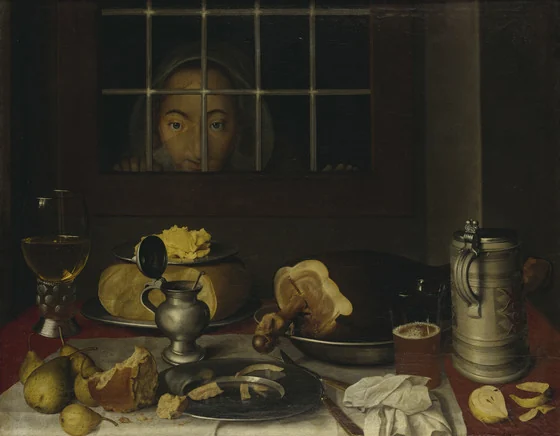
Heimbach’s paintings combine Dutch Baroque, Italian painting and Caravaggism. To explore: a laid table in the style of the period, modeled on the meal still life of 1670. Light it up with the lantern, and switch to the pure light-and-dark view.

Our own illustration, inspired by “Meal Still Life with a Maid behind a Window” (1670, Museumslandschaft Hessen Kassel): Roemer with wine, pewter pitcher, cheese and butter, ham, pewter tankard, bread, pears, a plate with a knife and a linen cloth on a red table. We leave out the maid at the window. It is not the painting.

One of the influences in Heimbach’s painting. In the early 1630s he probably continues his training in the Netherlands, supported by Count Anton Günther.

Heimbach works in Naples, Rome and Florence. His patrons include the Medici, Prince Piccolomini and Pope Innocent X.

The Landesmuseum names Caravaggism as an influence. Generally known: painting in the wake of Caravaggio relies on strong light-dark contrasts. Light falls deliberately on figures and things, the rest sinks into shadow. Try it out on the left with the lantern.

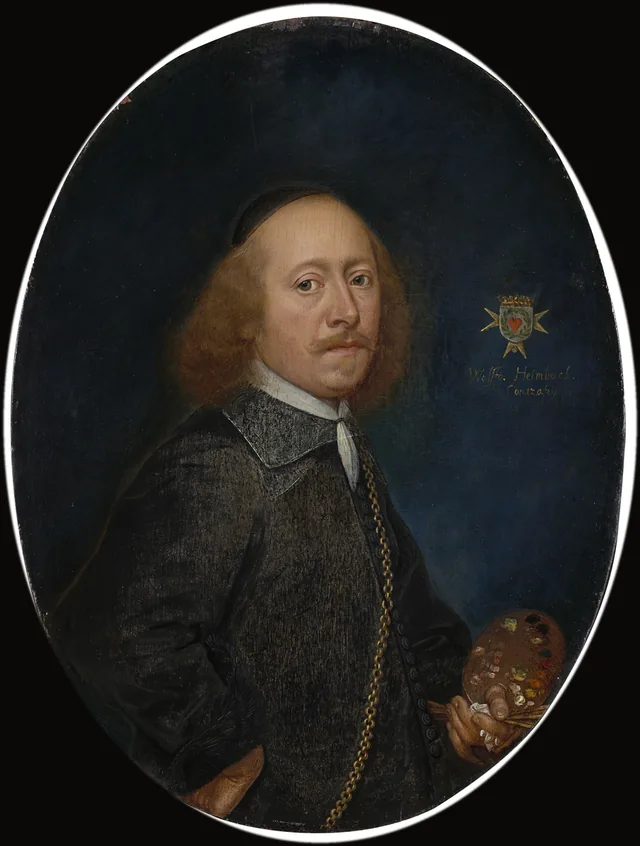
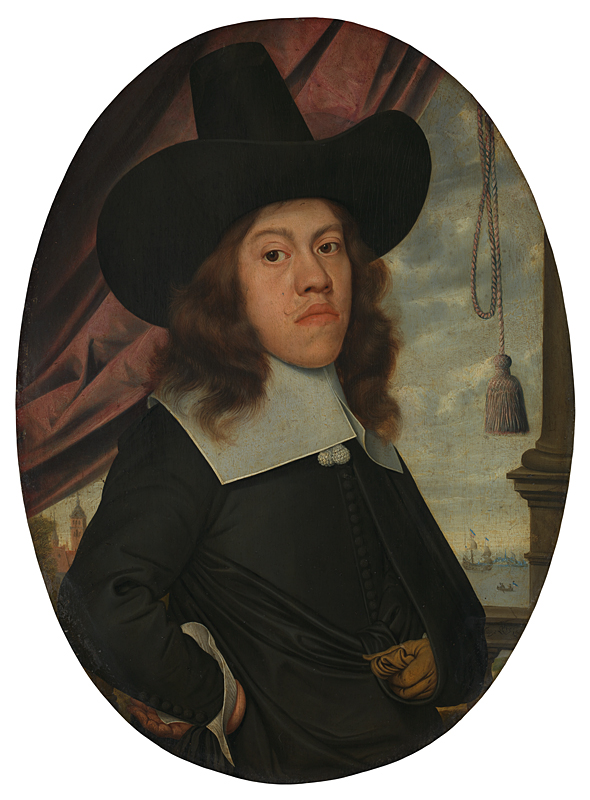
For about eight and a half years Heimbach paints for the Danish King Frederik III. Portraits appear from the very beginning: in 1636 the portrait of Christina Graevaeus, in 1660 his self-portrait, in 1664 the miniature of Count Anton Günther.

A table as if someone had just left the meal: cheese, ham, bread, pears and wine. Behind a broken window a maid looks in. 69.5 × 84.5 cm, oil. Signed in Coesfeld, 1670.

Color workshop

How is oil paint made?

In Heimbach’s time there was no paint tube; it was only invented in the 19th century. Painters bought pigments as powder and ground them with oil into paint. Reach into the shelf, make your own oil paint and paint with it.

General information on Baroque pigments. Which of them Wolfgang Heimbach used is not documented. Lead white and vermilion are toxic and are no longer used today as they once were.

Hands-on station

The studio

  1. Pour pigment
  2. Add linseed oil
  3. Grind
  4. Paint
Choose a pigment from the shelf above.
Chosen pigmentOcher
0 %

Circle over the slab with a mouse or finger. The glass muller grinds powder and oil into a smooth paste. The finer the pigment is ground, the purer the color glows.

Simplified simulation. Grinding with linseed oil is general craft knowledge; we will add the source for it later.

Four works

His paintings on their travels

Wolfgang Heimbach traveled through half of Europe, and his paintings did the same. Today they are carefully kept in major institutions, and we are grateful for that. We own no original, but we know where they are at home. Four of them hang here, with notes on where you can meet them.

The paintings hang behind curtains. Press and hold a picture or pull the cloth aside.

All details follow the linked pages of the holding institutions and the catalog of the 2022 exhibition. Distances are straight lines from Ovelgönne.

A painter for princes, kings and a pope.
Deaf in the 17th century

How did he live and work?

Contemporary sources call Heimbach “deaf and mute.” Whether he was deaf from birth is unclear. He may have had some residual hearing.

In 2022, in the exhibition “Wolfgang Heimbach: Ungehört” (“Unheard”), the Landesmuseum Oldenburg asked how his deafness influenced his life and work and how his time dealt with disability.

Die Reportage ansehen
Keep exploring

Deeper into the story

Wolfgang Heimbach is more than one page can tell. These four offerings from other institutions lead you further, in the order we recommend: from the introduction to the individual painting. We thank all institutions that share their knowledge so openly.

All four pages belong to the institutions named and open in a new tab. The content was summarized as of the state of our research.

In the museum

We remember him in the Singers’ Room

Wolfgang Heimbach is one of the notable figures from Ovelgönne remembered in our permanent exhibition. Come by and discover the Singers’ Room (Sängerzimmer) on the upper floor.

In preparation

The Zedelius Sisters

The next digital station is dedicated to the women writers from Ovelgönne, with books and letters from our collection.

Sources and image credits

All information on this page is based on the following sources. We show images of paintings only with credit to the holding institution and the photographer. The rights lie with the museums and will be cleared before publication.

  1. Landesmuseum für Kunst und Kulturgeschichte Oldenburg: Exhibition “Wolfgang Heimbach: Ungehört” (“Unheard”), May 21 to August 28, 2022. landesmuseum-ol.de/ausstellungen/wolfgang-heimbach.html
  2. Landesmuseum Oldenburg: Die Heimbach-Story. landesmuseum-ol.de/digital-entdecken/die-heimbach-story.html. Self-Portrait 1660: LWL-Museum für Kunst und Kultur, Münster, photo Hanna Neander (according to the file name).
  3. Rainer Stamm and Hermann Arnhold (eds.): Wolfgang Heimbach. Exhibition catalog for “Wolfgang Heimbach: Ungehört,” edited by the Landesmuseum für Kunst und Kulturgeschichte Oldenburg and the LWL-Museum für Kunst und Kultur, Münster. Dresden: Sandstein Verlag 2022, ISBN 978-3-95498-679-8, funded by the Ernst von Siemens Kunststiftung. Source for travel stations, patrons, the contract of 1652, stays in Denmark and Münster, and the burial on May 1, 1679. Also the timeline and map “Wolfgang Heimbachs Lebens- und Reisestationen” (“Wolfgang Heimbach’s Life and Travel Stations”) from the same catalog. We have summarized the information in our own words.
  4. “Wolfgang Who?” Pageflow report on the exhibition. wolfgangwho.pageflow.io. Life stations, patrons and burial on May 1, 1679.
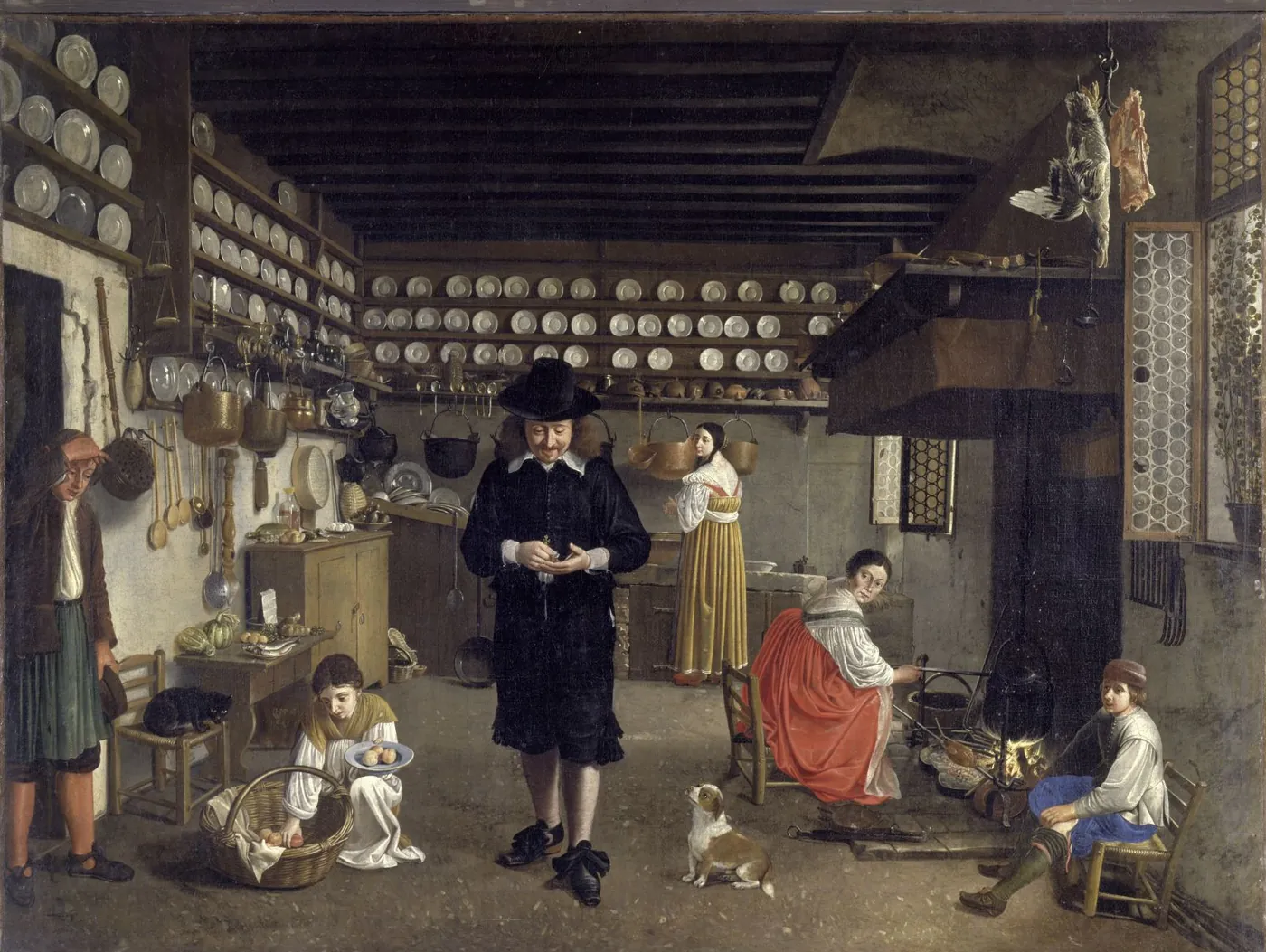
  5. Germanisches Nationalmuseum Nuremberg: Object catalog, Wolfgang Heimbach, Kitchen Interior, Inv. no. Gm1346. objektkatalog.gnm.de/objekt/Gm1346. The catalog gives his dates as “before 1628 to after 1678” and spells the name “Hembach.”
  6. Kitchen Interior, 1648: Germanisches Nationalmuseum Nuremberg, Gm1346. Image credit as shown on the image: “© Germanisches Nationalmuseum, Photo: Monika Runge.” No license is given on the catalog page; use must be cleared with the museum.
  7. Self-Portrait, 1660: LWL-Museum für Kunst und Kultur, Münster, Inv. no. 2037 LM, online collection. Photo according to the image file: © LWL-Museum für Kunst und Kultur, Westfälisches Landesmuseum, Münster / Hanna Neander. No license is given on the page; use must be cleared with the museum.
  8. Meal Still Life with a Maid behind a Window, 1670: Museumslandschaft Hessen Kassel, Gemäldegalerie Alte Meister, Inv. no. GK 613a, online database. Image credit as shown on the image: “© Museumslandschaft Hessen Kassel”; the page states “© Hessen Kassel Heritage 2026” and no license. The cover image of the catalog gives “Ute Brunzel” as photographer. Use must be cleared with the institution. The image is available only at 560 pixels in width and is cropped at the bottom edge to hide the burned-in lettering strip.
  9. Portrait of a Young Man, 1662: The National Gallery, London, NG1243, object page. The image is published under the license Creative Commons Attribution-NonCommercial-NoDerivatives 4.0. We use it unaltered and exclusively non-commercially. Image credit: © The National Gallery, London; Photography and Imaging, The National Gallery, London.
  10. Map: Today’s coasts and borders: Natural Earth, public domain. Distances are straight lines, calculated by us.
  11. Stylized portrait: Our own graphic treatment (line engraving) after the self-portrait by Wolfgang Heimbach, 1660, LWL-Museum für Kunst und Kultur, Münster; photo according to Landesmuseum Oldenburg: Hanna Neander. The origin and rights of the source image remain to be checked.
  12. Baroque pigments, general: Lead white (stack or Dutch process, improved in 17th-century Holland), e.g. Natural Pigments. Smalt (cobalt glass), e.g. WebExhibits and National Gallery London. Earth and other pigments: TU Wien, lecture on pigments. To be checked: vermilion, sienna, grinding with linseed oil (general knowledge, source still missing).