Transcription by the museum, read twice. Spelling and punctuation as in the original. Please report any errors. The page currently open in the book is highlighted.
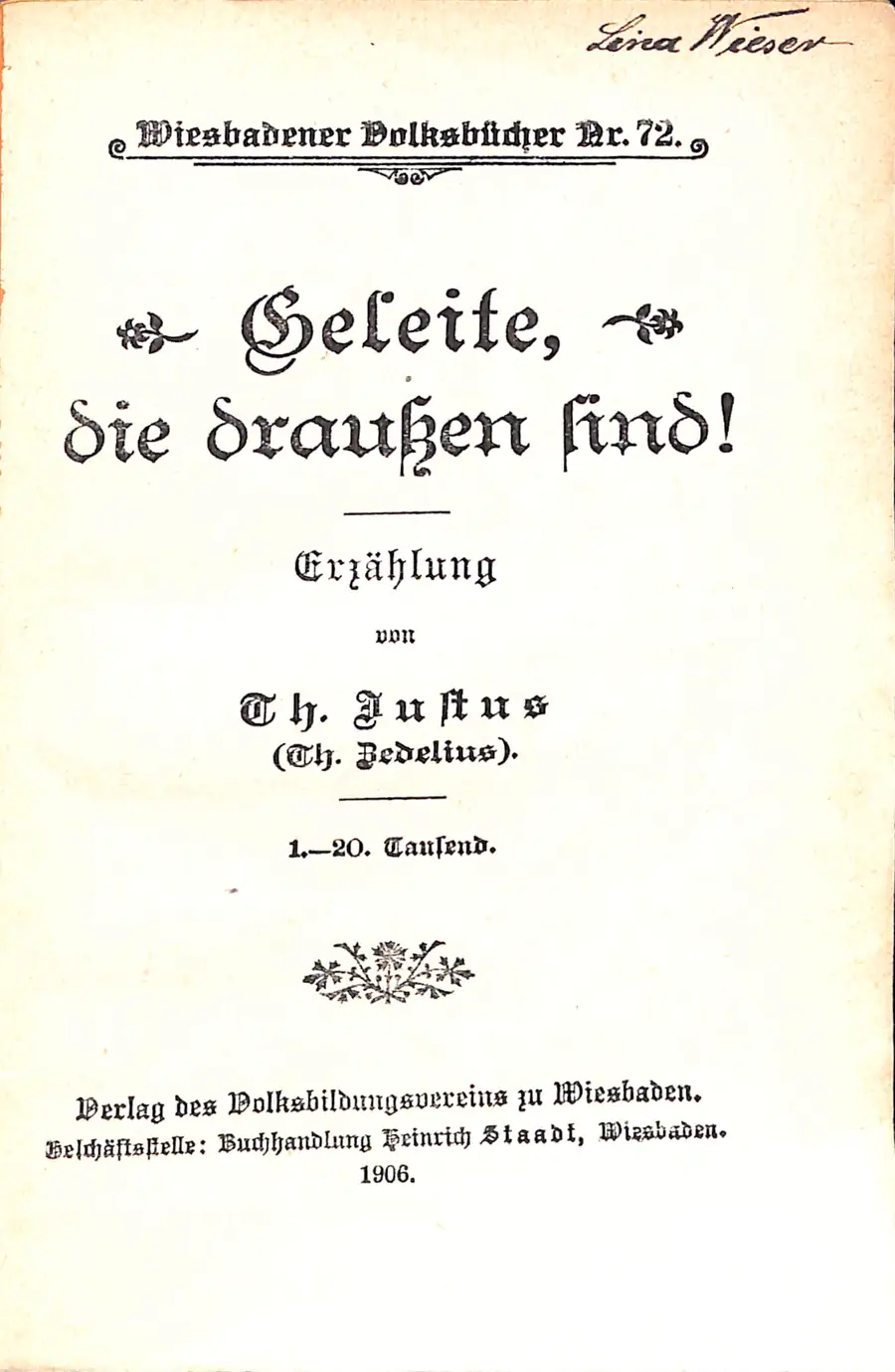
Title page
“Geleite, die draußen sind!” (“Guide Those Who Are Out There!”)
A Tale by Th. Justus (Th. Zedelius)
1st–20th Thousand
Publisher: Association for Popular Education in Wiesbaden (Verlag des Volksbildungsvereins zu Wiesbaden). Office: Heinrich Staadt Bookshop, Wiesbaden. 1906.
Page 2
Reprinted with the permission of the authoress and the publishing house from “Am Küstensaum” (“At the Coastal Fringe”). Tales by Th. Justus. J. G. Cotta’sche Buchhandlung Nachfolger, Stuttgart and Berlin.
Printed by Carl Rembold, Heilbronn a. N.
Introduction by Friedrich Bernt, Weimar, November 1905
Page 3
Introduction
Th. Justus is not a name familiar to the wider circles that take an interest in the art of German storytelling. The art of the authoress whom we here introduce to the reader under that name is rooted in her native region; from it she has drawn the subjects and characters of her tales, and the soil of home has proved lastingly fruitful to her. What it offered her by way of material, in things and in people, was certainly not very much in breadth; but the observer’s love even for what is unassuming, behind which she saw what is of worth in a higher sense, together with her exact knowledge of the land and its inhabitants, has helped to shape a series of admirable pictures whose warmth and clarity attract us refreshingly. The surroundings and habits of her childhood and youth directed Th. Justus, from the first awakening of her consciousness, to give searching attention to the world about her, with its charm that cannot be seen at first glance, and to look into the hearts of the reserved people who have dwelt since time immemorial on the water’s edge, to see what was lovable and distinctive in them. On 25 January 1834 Theodore Zedelius — such is her name in civil life — was born in the little Oldenburg town of Ovelgönne, the daughter
Page 4
of a respected physician, a man of earnest and rich scientific aspiration, and of a mother gifted with a lively receptiveness to poetic impressions. Of two sisters, the elder, eight years her senior, who after a life spent together with the authoress for many decades preceded her in death in 1892, shared with her the inheritance of the sensitive mother, the capacity to take in lasting and valuable impressions. Theodore Zedelius liked to accompany her much-occupied father on his professional journeys and on trips to the sea and into the neighbouring regions. In this way she was able to gain deep insight into the life and doings of the seafaring people, of those who sailed out and especially of those who stayed at home, with their hardship and their small and great sorrows and their rarer, simple joys, their inclinations and their views. In happy and grateful remembrance of that time, the authoress, at the age of sixty-four, confessed “that the indelible love for the places of my childhood and youth, for the marshes, moors and heaths over which the breath of the North Sea passes, and for the islands around which its waves surge, has accompanied me throughout my whole life, through sunny days and through gloomy ones. And no less the love for the people who inhabit this soil — this taciturn, reserved race, anything but amiable and obliging, and yet so profound, so capable and so honest-hearted!” In later years the female members of the family moved to Oldenburg; the sisters lived here together, and from here issued the numerous tales of Th. Justus, which appeared in collections of popular literature (such as the “Hausschatz deutscher Erzählungen” (“Household Treasury of German Tales”) and the “Neue Volksbücher” (“New People’s Books”)) and in periodicals
Page 5
and newspapers, and afterwards in part were gathered into three volumes. Nothing further has become known of her later life; nowhere does the authoress speak of it; she supplied only a few dates for Franz Brümmer’s “Lexikon der deutschen Dichter” (“Lexicon of German Poets”) and made mention of her loving attachment to the scenes of her youth in the preface to the collection “Auf heimischer Erde” (“On Native Soil”). It was probably an outwardly uneventful life, the quiet existence of an unmarried woman who dispensed the riches of her heart within a narrow circle, yet was not content with that, and shaped them poetically into pictures. At more than seventy-one years of age, Theodore Zedelius passed away in Oldenburg on 10 June 1905. Nowhere in the literary journals was her death mentioned, and no appreciation of the authoress was to be read on the occasion; she had always held herself back during her lifetime, and so her departure too passed unnoticed. The larger educated public had indeed become as little acquainted with her as she had attracted the attention of men of letters — with one exception: Richard Maria Werner devoted a study to her in his collection “Vollendete und Ringende” (“The Accomplished and the Striving”), published in 1900, in which he, probably as the first, points with great warmth to the inner beauty of the authoress’s poetic world, which has far too few friends, and in an excellent investigation shows, by many particulars, what gives the tales of Th. Justus their own charm and makes them so captivating and so moving in so many ways. Werner prefixed to his essay a portrait of the authoress; it shows a finely formed face with an expression of gentle friendliness and plain kindliness about the mouth and in the clear eyes, which look out calmly and gravely, but which can certainly smile cheerfully. It is
Page 6
the face of a genuine and noble German woman, and wholly a woman is Th. Justus in her writings too. True, she tells in none of them of great love, of the passionate drawing of two hearts toward one another; this need of the human heart emerges, on the whole, to only a slight degree, and where it does, it appears as a warm affection without extravagance, which, in spite of the resistance of the world and of circumstances, often after long years, takes a happy course. When the union of future spouses threatens to come about in so businesslike a manner as in the story “Durch Trübsal” (“Through Tribulation”), where the death of the bride dissolves the relationship that promised misfortune, one need not lay that to the account of the narrator. She is a realist, and knows how many a situation in life can move otherwise worthy married people to such sober interference in the stirrings of their child’s heart; this rational, never base side of her nature also belongs to the picture of the people whom Th. Justus wishes to make familiar to the reader in every characteristic action. Deliberate and well considered are these composed people; impulsive action is not their way, but they delight us by their steadfastness and capability. A tale like “Ruhig Blut” (“Keep Calm”) — like the one just mentioned, in the collection “Auf heimischer Erde” — shows us that the repellent conceit of infallibility need by no means be at play; the active and upright, yet somewhat self-righteous Becka Behns confesses to her betrothed Menno Depke, with whom she is united once more after a long separation: “it was probably bound to happen that we two had first to be knocked to pieces a little and learn to bow our necks.” The bliss of sweeping love has, as we see, found in Th. Justus no
Page 7
passionately convinced advocate. But the happiness and sorrow of the family she portrays again and again in rich and splendid colours; the relationship between parents and children arouses her sympathy above all else and spurs her to untiring depiction. The existence of the people on the coast harbours, more than that of others, anxiety for husband and son, who are out there, often for years, and easily stay out there. To this anxiety is added the common lot of mankind, with its discord and conflict. In the splendid tale “Unter schlichten Leuten” (“Among Simple Folk”) — the third in the collection “Am Küstensaum” — such a family picture is unrolled, which sets the authoress’s gift in the brightest light and makes the strongest tendency of her nature plainly visible. Frau Wehrkamp, who lost her husband early, must give up her son Heinrich to the life of the sea and remain behind in straitened circumstances with her ailing little daughter. She wins the affection of her landlord, a well-to-do, lonely peasant, innocently burdened by a suspicion, and trustfully gives him her hand. For that very reason, however, the son turns away from her; from afar he will return home no more and hardens himself against his mother, from whom the little daughter too is taken away, and who must now shut up within herself all her motherly love and longing, until, after years of inward deprivation, the matured Heinrich comes back to her and to his second father, bringing with him the proof of the latter’s innocence. Beside these chief characters Frau Scholl comes to the fore, the housemate and faithful helper of the Wehrkamp family, an old, odd woman without kin or other friends; she must have some person for whom she can toil, and so, after the close companionship
Page 8
with those others has come to an end, she turns her need to love to a helpless, half-childish old man. “Is it not now the greatest happiness for me that I have someone again for whom I can care?” It is the feeling of the woman, alive at its best, that speaks here. Such figures, a little eccentric, a little awkward and good to the core, were created by Wilhelm Raabe, with whom our authoress shares the inclination toward the little people — to be sure, with a different wealth of colour and a power of comedy of which Th. Justus has little, although she can on occasion take amused delight in a suitable character, and surveys her world in her own manner with a fine and loving humour.
The bitter struggle for outward existence, privation, the anxiety for those who work far away under constant danger, are the predominant things in this world. Into what temptation even the best may be driven is taught by the excellent story of the shore, “In Sturm und Wetter” (“In Storm and Weather”) (published by Reclam), in which an honest islander comes out of the threatening trial, without having become guilty, only through a fortunate turn of events. This leads us to tales in which, with too great an optimism, the struggles and conflicts end peacefully and to the happiness of all concerned, whereas life far more readily leads them, with shrill discord, to a tragic end, to catastrophe or to a renunciation that is no longer able to enjoy any joy unalloyed. But that she does not evade grave necessity either, that for the irreconcilable discord which sets man against man wherever he goes, with all its torment, she strives for no improbable reconciliation, certain tales of Th. Justus leave beyond doubt. Such is “Wider einander” (“Against One Another”) (Ulr. Meyers
Page 9
Bücherei, No. 13), in which she successfully reaches back into bygone times that granted to the lords of the manor a right over their serfs which seems to us incomprehensible. The misery which arose from the abuse of this almost unlimited power for the rightless, enslaved peasants, and their fruitless yet ever renewed revolt against the oppressive compulsion, are depicted here without any embellishment that seeks to soften and gloss over what is all too harsh; we see the happiness of a small family destroyed by brutal encroachments, and we feel, to be sure, also that the authoress stands at heart on the side of the high-minded young prince, who, in his endeavour to put a stop to the manifest injustice, meets with the loud and still more with the silent, tenacious resistance of the nobility, and finds the same view only in his aged tutor, a true nobleman. Yet even what strikes one as too optimistic in Th. Justus never seems untrue, but is the reverse side of the noblest human feeling, which stands out with warm radiance against the gloomy background of struggle and suffering; the reverse side of the never-failing readiness to help, which takes up the cause of the distressed neighbour and keeps off the most glaring want; and of the deep sympathy with the anguish of another’s soul. How the ray of caring love falls, transfiguring, into a gloom that has almost become hopelessness, how a wounded spirit, driven back upon itself, gently unfolds once more, under cordial understanding, into life-giving cheerfulness — it is such a development that Th. Justus loves to follow, with that genuine womanly sympathy which instinctively solves the riddle of the heart oppressed by a heavy burden, and knows what soothes and heals. This ability proves itself as beautifully in “Unter schlichten Leuten” as, for
Page 10
example, in “Aus mit der Ebbe — heim mit der Flut!” (“Out with the Ebb — Home with the Flood!”) (likewise in “Am Küstensaum”). Amid the East Frisian people, who tenaciously maintain themselves in their old way of thinking and their old customs, the observer could not fail to notice what a share in many a heavy sorrow belongs to prejudice, to the rigid clinging to habit and to what has been handed down. If she gladly depicts, and from rich observation, the reverently preserved customs of the land, everything in her rebels against their degenerate form where she recognizes it as the source of such cruelly striking wrong; but she turns against it not with loud scolding but, as it were, by the practice of what is better; she makes amends for injustice by the pure humanity of a woman who follows not the general opinion but her own inner voice. The preface to the collection “Am Küstensaum”, published in 1890, gives in simple words an account of her fundamental conviction, that in breaking loose from blind prejudice we must undergo a baptism which gives us the strength to feel ourselves free and to become true human beings; and of the fact that to contribute to this insight, to help accomplish this task, is the fairest task that hovers before the authoress.
The dangers of the sea, and the labours directed toward checking them, which stand out strongly and perpetually for the dwellers on the coast, are naturally also an object of the liveliest interest for Th. Justus. Frequently she describes the building of the dikes, which is to surround the marshes protectively and to drive back the wild North Sea; it is of great importance, for the fate of men is closely bound up with the treacheries of the elements, and a storm tide can swallow up boundless happiness and property, worse than when, inland, a hailstorm robs the farmer of a
Page 11
harvest. To depict the works of protection and their perils, and their influence on the life of the inhabitants, has been achieved excellently in the charming historical tale “Lawei” (“Auf heimischer Erde”), and in the sketch “Auf dem Watt” (“On the Tidal Flats”) (“Strandgeschichten” [“Tales of the Shore”], published by Reclam); in the latter it compels us to follow with all our senses how nine weather-hardened men barely escape the fate of being laid “in God’s coffin.” These and similar tales are never calculated for mere suspense; the simple art of the authoress always raises them to a higher level of representation than mere description; and this art knows how to carry us away when, as in “Aus mit der Ebbe — heim mit der Flut!”, it lets us live through the tragic end of a young man on the treacherous tidal flats, which reacts so movingly upon the friend who believes himself guilty. It is the fate which is also prepared for many a son of the coast when his calling leads him out upon the sea, which can invite so caressingly, but can also, raging fearfully, claim its victim, at the coastal fringe as on the shoreless expanse. Then a chamber remains empty that was carefully made ready for the one who was to return, and a glad hope flickers uncertainly and at last goes out. That, however, is not the way of Frau Ahlke Tetens, who stands in the foreground of our tale “Geleite, die draußen sind!” Her hope for the return of her only son, whom no one else any longer expects, remains awake, her touching confidence undiminished, and doubt besets her only when the court has declared the distant one dead and the pastor will no longer include him in the prayer for the men “who are out there”; yet after death has taken the clergyman’s own mother from him, she still lives to experience the
Page 12
shattering joy of hearing her son’s name once more in the church, and from this high point death calls her away. How unassuming it all is, and yet with what love it is steeped, how much poetry the authoress has known how to draw from this simple event, recurring a hundredfold! In face of the strength of feeling in this concise story, the saying of Goethe involuntarily presses itself upon one, which Th. Justus placed before the tale “Unter schlichten Leuten”: “In this poverty, what abundance!” The tale naturally does not represent the authoress as a whole; the way to her will be found by whomever this little book makes desirous of winning in Th. Justus a dear and welcome friend of the household. Among her most moving and most beautiful tales, however, is “Geleite, die draußen sind!” R. M. Werner too felt thus, and devoted a large part of his study to this story, stressing how its author “starts from what lies nearest and arrives in the very heart of the deepest, most deeply felt poetry,” and how she knows how to set hidden poetry free. This precious gift reveals itself indeed, with rare purity and beauty, in this little Song of Songs in praise of trusting mother-love, and it will certainly help to enlarge the circle of those who gratefully make their own many of the simple and heartfelt tales of Th. Justus.
Weimar, November 1905.
Friedrich Bernt.
The story
Page 13
In the little harbour town on the bank of one of the larger rivers that carry their waters to the North Sea, all the ships had hoisted their flags in honour of the Sunday, and everywhere, on board as on shore, work was at rest. During the past week it had been all the livelier; all day long the knocking and hammering had no more ceased than the screeching and creaking of the cranes, which lifted the cargo intended for the ships and, with a quick swing of the jib, lowered it into the hold prepared for stowing it. For since the ice of the river had broken up, all the various vessels, great and small, which this time had had to lie fast in their winter quarters unusually long, were making ready with all speed for departure, since otherwise the shipowners’ money would be dead capital. According to old and pious custom, the “seafaring people” who lived in the town or the surrounding country first made their church-going, in order — perhaps for the last time for a long while — to attend a congregational service together with relatives and friends. On roads and footpaths lay the bright March sunshine, in the fresh wind flags and pennants fluttered gaily, and high up in the blue sky the larks sang a chorus of
Page 14
jubilation. The faces of the churchgoers, on the other hand — men and women alike — wore an expression of quiet, composed gravity. Most of them, after all, faced a heavy parting in the near future — a parting from which long habit had indeed taken much of the sting, but which nevertheless, at every repetition, lay anxious and oppressive on the hearts of those who went away as of those who stayed behind.
A small family, consisting of father, mother, and two grown sons — the latter two in seamen’s clothes — was just passing a neat little house with a tiny front garden, when its door slowly opened and an old woman in faultless black “church-going dress” stepped out. Her wrinkled face was framed by a finely pleated white ruff, which lay against the black widow’s cap and let but little of the silver hair be seen. The aged woman still carried her figure perfectly erect; only the hand with which, turning round, she closed the door of the little house trembled slightly — a sign that her strength was not wholly unbroken after all.
“You are going to church too, I suppose, Ahlke?” the head of the family addressed her from among the passers-by, a movement of his head pointing to the hymn-book which she carried in her left hand, together with her very narrowly folded white handkerchief and a “Rukelbusch” of curly-mint stalks.
“Yes, of course!” was the answer, “and all of you likewise? Yes, I can well imagine! And the two lads go on their voyage tomorrow? — Ah, God, it’s hard, it’s hard!” she went on, falling in with the little
Page 15
company, and speaking more to herself than to the others, “just such a bright Sunday it was, just such a one, the day before my Folkert went away.”
“Children,” Jasper Hinrichs, the father, now broke in quickly, “we mustn’t loiter, though! The bell will have stopped ringing in a moment, and the pastor can’t bear it when people come after the singing has been struck up.”
“It’s really something dreadful, this bell of ours!” the elder of the two sons took up, evidently with the intention of supporting his father and diverting the old woman from the memory of her son. “Not a single parish in the whole district has such a wretched jangling as we have. We ought to be ashamed that we still haven’t managed to get a proper peal of church bells!”
“Folkert always said that too,” the old woman confirmed with a nod. “Every time it came up he declared: ‘Mother, as soon as I am a mate, I’ll lay by a month’s pay or two from every voyage, and a few of my comrades want to do the same. It would be strange indeed if we hadn’t soon got together as much as a bell costs.’ Yes, that’s what he always said, and he will surely make his word good yet. For even if I haven’t heard from him for a long time now — he must come back some day!”
With these words they had reached the church door and now entered the house of God. On the right, in the choir stalls, the women took their places according to old custom, on the left the men. After a short prelude the organ passed into the melody: “Rejoice greatly, O my soul.” But the congregation knew very well that today
Page 16
no song of joy was to be sung, but that hymn which was known and dear to every one of its members under the name of the “Sailors’ Farewell,” and in which it ran:
“Lord, to whose praise and glory
Every drop of water flows,
Mighty God, whom wind and ocean,
Lightning and storm obey,
Take into your faithful keeping
Body and soul, ship and cargo;
Yes, may you yourself, for blessing,
Lay your hand upon the helm.”
Every spring, when navigation was opened again, a service was held which referred exclusively to the feelings of those who went out and those who stayed behind, and on this Sunday above all that old hymn, so moving to all and at the same time so full of comfort, could never be missing. Once, when old Pastor Lindemann lay ill and a candidate preached in his stead, another hymn had been put down for singing in place of this one, which began: “Supreme Helper, be not far off!” But with this innovation the people had been very ill content. If the Sailors’ Farewell was not sung on that Sunday, they said, it was nothing, and there could be no question of edification at all.
Today, then, the time-honoured hymn was sung devoutly, with all its verses. The sermon, too, which plainly and warmly stressed the meaning of the day, was followed with more attention and devotion than was otherwise perhaps the case. It was followed by the customary church prayer, which the venerable old clergyman,
Page 17
as always, read from the service book, and to which the congregation listened with the usual half-thoughtless gravity. All faces grew more animated and tense, however, when the pastor now closed the book and, folding his hands anew, went on: “And now, O Lord, we beseech you: guide all those who are out there! Especially we ask your gracious protection for a bachelor bound for the East Indies, a captain and two brothers bound for New York, a captain bound for Galveston, a bachelor bound for Rio, and a brother bound for Sydney. Lead them safely through storm and surge of waves, and let them, by your grace, reach their home harbour in health. Amen!”
This intercession was the real event of every Sunday service, and its form was unalterably fixed. The captains received once and for all their title; the married seamen and mates were the “brothers,” the unmarried able and ordinary seamen the “bachelors.” The “bachelor bound for the East Indies,” however, was the son of Frau Ahlke Tetens, and had now for four years stood at the head of the list of those for whom the church prayer was said. The old woman nodded with satisfaction, as always when the intercession for her only one rang out before the whole congregation; nor did she notice that those sitting nearest her looked at her with pity and a gentle shaking of the head. There was no one in the whole assembly who would have left room even remotely for the possibility that Folkert Tetens was still alive and could ever return. Only the mother held unswervingly to this belief and this hope. For her it was only a matter of being patient until the moment which some day was bound to
Page 18
come, when her son would stand before her again and she would clasp him in her arms. — “She’ll learn it soon enough,” the people would say among themselves; “to take this confidence from her — no, one couldn’t find it in one’s heart! And it might still be possible, too, that she would die before she learned the truth.”
“I keep thinking it can’t be kept from her much longer,” remarked Jasper Hinrichs on one such occasion, who was a distant relative of Frau Ahlke. “Klaus Tönjes has said more than once that he will have to ask her to apply with him for the declaration of death. And if one wants to be fair, one must admit it: at bottom you can’t blame him. He can’t get at the inheritance before, and with the troop of children he has, he must surely long to be able to move a little more freely.”
Klaus Tönjes was the son-in-law of old Ahlke Tetens. In his first marriage he had had her only daughter for his wife; but she had died in her very first confinement, and already on the next day the child, which had breathed only a few hours, had been laid in the coffin with her. “On that account,” then, the son-in-law, as Frau Ahlke thought, had not needed at all to marry again. Yes, if there had been a houseful of children — then, to be sure, a woman would have had to come into the house again, but as it was! For her part she saw no necessity at all. If the son-in-law was at sea, he had everything he needed on board of himself, and in the times when he stayed ashore she, Frau Ahlke, would quite well have been willing to look after him. Klaus
Page 19
Tönjes, however, must evidently have had his own views as to married life and housekeeping, for after a year’s time he stood before the altar for the second time. The fact in itself would have been hard enough for Frau Ahlke to get over. Besides, the young wife did not win her approval either. “She is too foß for me” (coarse, curt), she declared, “and too resolute, not at all like my Stina.” There came a time, however, when she was obliged to acknowledge, though half unwillingly, that the young woman’s strong and resolute nature had its good side after all, and that was when Klaus Tönjes, after the house had already filled with a whole flock of children, broke his foot by a fall from the yard, and, since it had healed again crooked, became unfit for the further practice of his calling. To earn bread for himself and his family he had now taken up the trade of a “stevedore”¹, that is, he had joined those who saw to the loading and unloading of ships, as well as the stowing of the cargo. For all these duties never fall to the ship’s crew proper, but always to the said guild of labourers. But since there was not work without interruption in this business, the earnings were scanty, and it could not fail to happen that the eyes of the harassed father of the family turned longingly to the small inheritance which was bound to fall to him sooner or later. For many years before, an uncle of his late wife had named this niece of his and her brother Folkert heirs of his small farm, with the stipulation, however, that the division of the inheritance should not take place until Folkert had come of
¹ In the original “Sjouvermann”, pronounced “Schauermann”. The word is of Dutch origin.
Page 20
age, but that until then the farm should be managed on account of both parties. By this arrangement he had wanted to leave his nephew a free hand to farm the little property himself, in case he should have grown weary of a seaman’s life by the time he had in view. But just a year before he came of age, Folkert had set out on that voyage to the East Indies from which he had so far not returned. The income of the small property had meanwhile been accumulated, and Klaus Tönjes, who had lived in community of property with his late wife, was the one to whom half of the whole inheritance was due — only, unfortunately, he could not get at it so long as every scrap of news about his brother-in-law’s whereabouts was lacking.
On the very afternoon of the Sunday with which our story begins, his mother-in-law saw him coming towards her little house. That was not in itself anything so rare, for one had to give Klaus Tönjes his due: however unsociable he was otherwise and however roughly he bore himself, he had never yet done anything amiss towards the old woman; towards her he showed rather a consideration of which no one else in his circle could boast. Strangely enough, however, this made not the slightest impression on Frau Ahlke; for her part she met her son-in-law for the most part rather bitterly and curtly. It almost seemed as though in the course of the years his wife had found still more favour in her eyes than he himself. Today, too, she set herself, as it were, in an attitude of defence as she saw him take the road to her house. It flashed through her mind that he would want to urge her once more not to
Page 21
go on living alone as she had done hitherto, but to take in some younger person to whom she could hand over the work and by whom she could be looked after. Such a proposal, however, was downright ridiculous! If she was no longer to work, she had declared more than once to him and to others, they might as well take her straight to the churchyard. And she could not possibly imagine anything more dreadful than to be “looked after,” that is, to be stared at and questioned. So on that point the son-in-law might spare himself every word! — She was resolved today too, firmly resolved, to send him “packing” again just as before. But Klaus Tönjes’s thoughts were directed today to quite other things than a companion or a nurse. After some introductory remarks about the weather and the resumption of the spring work, he began, as with a violent run-up: “Mother, I’d like to talk something over with you — don’t take it amiss, now! It’s no graspingness (greed) on my part, but you may believe me — it’s growing over my head — the expenses with all the boys are quite beyond what I can raise, and with my health it’s just so-so, as it is! And so I’ve thought it over from every side — it really can’t be done otherwise — otherwise I can’t get at the inheritance, which is mine by rights — and so we have to — apply to the court for the declaration.”
“What kind of declaration?” asked the old woman, looking at him with wide eyes.
“The — oh, I only mean — there’s nothing in it at all — and nobody dies of it,
Page 22
so long as he is otherwise still alive — but it — it surely has to be, that the declaration of death be applied for.”
“The declaration of death!” The old woman said nothing more, but there lay such abysmal pain in that one word that Klaus Tönjes, who was not otherwise among the tender-hearted, passed the back of his rough, horny hand over his eyes and then looked out through the window into the little front garden so intently, as though never in his life had yellow daffodils and blue grape hyacinths come before his eyes.
For some minutes nothing was heard in the little room but the ticking of the old Black Forest clock. At last Frau Ahlke began again — and one could plainly hear how she strove to suppress the trembling of her voice —: “But if he is now declared dead by the court and yet comes back after all — as I firmly believe — how will it be then?”
“Then everything is in order, Mother, and all is well. What of the inheritance falls to his share will be made over to you, and you keep it for him. That presents no difficulty at all.”
“Is that quite certainly true?” she asked distrustfully.
“Quite certainly true!” he affirmed. “Ask lawyers as many as you like — every one will tell you exactly the same.”
Frau Ahlke made a disdainful movement of her head. “I’ve no use for lawyers, none at all! ‘The more learned, the more perverse!’ my mother always used to say, and all my life I’ve found it confirmed. No, the man I would like to ask is old Rahmann the accountant; he beats all the
Page 23
lawyers, however many of them there are, into his pocket. I will speak with Rahmann, and then you shall have your answer.”
— Rahmann’s information must evidently have turned out in the sense that Tönjes had assumed. On the next afternoon the old woman, dressed in her black church-going gown, appeared in her son-in-law’s house and, after they had pressed her to sit down, declared with a certain solemnity that since Folkert’s money was to fall to her — “for safekeeping,” as she emphasized — she had no further objections to make to “the declaration” — she did not say “declaration of death.” She looked so pale and worn as she said it that Klaus Tönjes and his wife were suddenly filled with deep pity and felt quite guilty themselves. She declined all invitations to stay longer. The daughter-in-law hastily reached the coffee mill down from the shelf and promised to make an extra good coffee. But Frau Ahlke declared that she had already drunk, and besides — her stomach might not be quite in order, for she had no appetite at all for eating or drinking. That came, no doubt, from this unnaturally warm weather; and with that she wiped her wrinkled, pale face with the white handkerchief, which she carried with her today as at church.
The next morning Mine, the daughter-in-law, driven by an inner uneasiness, set out early to see how she was. “I don’t know,” she said afterwards to her husband, “I don’t like the old woman at all! One can’t exactly call her ill, but — I don’t know how to put it, she is quite different from usual, really not to be recognized at all!”
Page 24
Yes indeed, she was right: different, quite different from usual the old woman had become! It seemed that she was broken in her innermost courage to live. Whereas formerly she had always still worked briskly in her little household, in the garden and at the spinning wheel, every task now seemed suddenly a burden to her. For hours she could sit with her head propped on her hand and brood silently to herself. After their earlier experiences, Klaus Tönjes and his wife did not venture to approach her again with the proposal that she should take someone into the house. All the more surprised, therefore, was the son-in-law when one day, as he looked in on her for a while at twilight, she put the question to him whether it could be managed that his Alma, whom he had after all once offered her before, should come to her. She now often felt so tired, she said, that she saw it was better for a younger hand to take the work off her, at least when she could not quite manage. He agreed on the spot, remarking that this very day Heinrich, his eldest, should write to his sister. Her stay in the town had to come to an end in any case, the thing was getting too expensive for him, and if she still could not “manage” the millinery which she had now been practising since Christmas, then she would never learn it at all. Frau Ahlke nodded to this and declared that she might bring along her whole stock of ribbon and flowers and whatever else was needed, and carry on the business here. In the room opposite there still stood a glass cabinet; properly it belonged to Folkert, but for the time being she would give it to Alma for her use. She must of course have something to do; the bit of housework would not be enough for two, and the young things of nowadays did not spin any more; so there remained only the
Page 25
millinery, in which she would surely, it was to be hoped, be so quick that she could do “her bit” even without a mistress to teach her.
Alma arrived, too, before a fortnight had passed, with a newfangled high coiffure, a wholly altered pronunciation in which, among other things, the G had been changed entirely into K, and a countless number of pasteboard boxes, which she called “cartons,” to the astonishment of her whole family. Frau Ahlke looked and listened to all this with a distrustful face, and it was quite in her old manner, in the tone in which she declared that evening to her son-in-law, that if she had known what “carryings-on” all this was with Alma, she would have taken good care not to take her into the house. Klaus Tönjes himself was by no means pleased with the change that had come over his daughter. But he begged the grandmother to have patience for the time being; the newfangled ways with the hair and the odd way of speaking had probably been picked up in the millinery business. That would, he hoped, wear off if she had only once been among “sensible” people again for a while. But if she should fail in any way in her duty, and not behave to her grandmother as was fitting, he would one day show her how the rake sits on the handle.
Frau Ahlke, however, had no further cause to complain of her granddaughter. Alma was at bottom a good-natured creature, and the silly ways she had acquired did not go deep. She cared for the old woman to the best of her ability, and patiently let her tell the endlessly long stories from Folkert’s boyhood, of which she soon knew every word by heart. That her thoughts, meanwhile, dwelt far more on the big red roses and the blue
Page 26
fancy flowers, with which she trimmed, in pleasant alternation, the black tulle caps of the peasant women, than with the life story of her lost uncle, could certainly not be held against her. By her, as by her family and virtually the entire population of the place, he had long since been laid among the dead.
Summer and autumn passed without anything particular happening. Once or twice Frau Ahlke had asked her son-in-law whether “the declaration” had been issued yet. He would answer no and quickly turn the conversation to other things, lest she suddenly come out with the question of when it was to be expected. The period for reporting the missing man expired at the end of March; but the old woman had no more need to learn anything of this date, or of the declaration of death that followed it, than until the court took the further steps necessary for settling the estate. In Frau Ahlke’s mind, however, with the passing of time the conjecture grew ever firmer that the court had either “forgotten” the matter or else — which would be very sensible of it — had not wished to regard her Folkert as dead, and that therefore no declaration of death would be issued either. When she once came out with this opinion to her confidant, Rahmann, the shrewd old pettifogging attorney first looked at her in speechless astonishment. But it dawned on him at once that it was not for him to destroy this belief. So he drew out his large silk handkerchief and, polishing his horn-rimmed spectacles, remarked in an ambiguous tone: “Well, well, one cannot tell how such things hang together. Droll things often happen in court — quite droll things!” — an
Page 27
answer with which Frau Ahlke was perfectly content.
In the course of the winter old Pastor Lindemann, who had faithfully held his pastoral office for so many, many years, died after a lingering illness, to the general regret of the congregation. The new pastor, who was installed by the consistory, was a fairly young, unmarried man who took his office very seriously, but who in his brisk, somewhat curt manner nevertheless offended people here and there. They also thought that in the intercession for the seafarers he really ought to pronounce the names of the ports a little better; for though it might be good enough for “every day” to say “Nju Orlihns,” it was only proper that one should say “Neu-Orleang” in the pulpit. That was High German and sounded better. And it was just the same with several other names. The way he said Saint Helena sounded quite odd; it ought to be said Saint Helena.
The sexton conveyed these complaints of his seafaring parishioners to his spiritual superior, though not without some hesitation, but at first met with firm resistance. Only repeated representations could convince the pastor that his hearers were positively distressed at this departure from what was time-honoured, and that the intercession had lost something of its solemn character through the innovation. From then on, captains, fellow-brothers and bachelors again sailed to Neu-Orleang, Saint Helena, and wherever else, according to the “correct” pronunciation, they might be bound. One simply had to make a concession now and then to the obstinacy
Page 28
of the people, the pastor once remarked with a shrug to a colleague.
In Frau Ahlke’s eyes the young clergyman had found favour ever since, on his rounds of the parish, he had called on her too and had let her Folkert be told to him at great length. That he had accustomed himself to the “correct expression” also gave her great satisfaction. One could see, she said, that he had the best of intentions. Not a single Sunday did she miss the sermon, and if its train of thought was sometimes a little too high for her, she consoled herself with the thought that her hearing was no longer as good as in former years, and that this was why she understood the new pastor less well than the old. She was not at all pleased that in the spring a stubborn cold confined her to the house for several weeks, so that going to church on Sundays had to be given up. “If only it weren’t for this cough, I would go all the same! But one only disturbs other people when one coughs in their ears; I never could stand that!” — Alma proposed to fetch Ems pastilles from the apothecary’s, saying that was the newest and best thing now. But her grandmother said: “Nonsense! Just the opposite: what is old and tried is always the best. Hot syrup with flowers of sulphur — if that doesn’t help, nothing will!”
Whether it was the syrup or the mild spring air — at any rate, the cough subsided, and on one of the last Sundays in April Frau Ahlke could once more set out for church. Alma did not accompany her today; she had been wanted at her parents’ house, since her mother intended to visit
Page 29
relatives in the country. So the old woman walked alone on her way, greeted here and there by the other churchgoers with a nod or a brief but kindly meant: “Well, back again? That’s right!”
In the House of God it was not as full as it often was. Many of the “seafaring folk” had gone to sea again after their winter rest, and three weeks before they had already sung the “Sailors’ Farewell.” But the sermon was today particularly beautiful and edifying — or so at least it seemed to the great majority of the hearers, and to Frau Ahlke as well. For the preacher spoke of an eternal reunion that would one day unite anew those who had loved one another here on earth, and of the harbour into which all would one day sail, however wildly their little ship of life might be tossed hither and thither by storms down here. Many eyes shone moist, and Frau Ahlke too passed her handkerchief over her face and then clasped her hands more tightly together — it was truly wonderful how “refined” the pastor could speak! Now followed the customary prayer of the church, and then the intercession for the absent. There — what was that? Her Folkert was left out; the “bachelor bound for the East Indies” did not open, as he had for years and years, the series of those for whom the guidance and aid of the Most High were invoked! Had the pastor perhaps introduced a different order of things? Was his name perhaps to come later in the list, or even quite at the end? — But no! the intercession was finished, and no mention had been made of the bachelor bound for the East Indies! Like one stunned the old woman sat in her place, as if she could not grasp what she had experienced. Not until
Page 30
a noise all around her brought her somewhat back to herself; the congregation had risen, and the words of the Lord’s Prayer struck her ear. Then Frau Ahlke too rose, on trembling knees, but before the Amen had died away she sank heavily back into her seat. Then the closing verse was sung and the blessing spoken, and after a last silent prayer the general departure began. Frau Ahlke remained behind; she could not go home like this, she first had to try to speak to the pastor, to get from him some explanation of what lay behind the intercession, whether it was a mere oversight or something else. But just then several infants were being carried into the church to be baptised and — yes, now she remembered — two couples were to be married today, so the pastor was too much occupied and could not give her an answer. So, shaking her head sadly, she set out for home, the last of all. It was well that on the way she met no acquaintance. She felt as though a humiliation had befallen her which for the present could not be spoken of, not until she knew for certain how the matter really stood. At home she painfully missed her granddaughter, who had after all — she noticed it only now — grown dear to her in the course of time, and from whom she kept none of her thoughts and troubles. Well, she would come again in the afternoon. Perhaps she could then go to the pastor in her stead.
The old woman warmed her dinner, which was already prepared, over a brazier, and when she had eaten it without feeling even a trace of appetite, she settled herself in her great armchair
Page 31
for a nap. At first she could not get free of her thoughts; but gradually her fancies grew more indistinct, and when at last she opened her eyes again, she became aware that she must have slept for several hours. Where could Alma be? She had promised faithfully that in the course of the afternoon she would look in on her grandmother, so that the time until her final return in the evening should not seem too long to her. Frau Ahlke made her coffee and then sat down again at the window in the warm sunshine. On the windowsill lay some rolled-up newspapers; Malchen Hedenkamp, Alma’s best friend, must have pushed them in under the sash window while she was in the kitchen. Malchen was the daughter of the innkeeper Hedenkamp in the High Street, and the two girls would plunge with boundless zeal into the Capital Observer after it had lain out in the taproom for the customary time. Of the whole contents, to be sure, only the “story” that stood “below the line” was of interest, but that to such a degree that Alma, whenever she had been out, would often cross the threshold already asking: “Hasn’t the paper come yet?” The old woman took the sheets, covered with numerous beer and red-wine stains, from the windowsill in order to lay them on the little table that held Alma’s sewing things. It almost never occurred to her to cast even a passing glance at the contents of the newspaper. Why she did so just today she could not in any way have said; half unthinkingly her eye wandered over the lines, when suddenly it went through her body like an electric shock. There stood the name Folkert Tetens
Page 32
— it was no illusion of the senses! — before her on the paper. She read it once, twice, with silently moving lips — she repeated it aloud and then sank onto the nearest chair, weeping bitterly, her trembling hands pressed to her face. Her Folkert had been declared dead by the court! Now all at once she knew why the pastor had no longer prayed for him — what need have the dead of intercession? Now everything was irrevocably over and done! What she had held fast to year after year with a tenacity that nothing could shake, that had withstood all improbabilities — it was destroyed all at once by these few merciless lines! Oh, if only the dear Lord had been so merciful as to take her away before she lived to see this day, if only she had been able to go before her son! — But it was no use: she was still on earth and had to wait until her little hour came. Only what she had to do for the present, that she knew. She took the white-grounded flowered calico kerchief from her neck and tied on a little black woollen one. Then, while tear after tear slowly ran down her sunken cheeks, she rummaged in cupboard and chest of drawers and laid together various garments which Alma was to take this very evening to old Wedemeier the dyer, so that they might be dyed black.
When her granddaughter came home, she found her grandmother sitting in her armchair, her face fairly shining white through the darkness.
“Grandmother!” she cried, full of fright and concern, “are you ill?”
The old woman shook her head. “No, nothing ails me, but my Folkert is dead.”
Page 33
“Has word come?” asked Alma, dismayed.
“There, it’s in the newspaper!” and she pointed with her finger at the sheet lying before her.
“Oh, in the newspaper . . .!” Alma did not finish. She, like her father and all the other acquaintances, had read the long-expected declaration of death ten or twelve days before, and the paper in question had been carefully hidden from the old woman. That the announcement would be made once again no one had counted on, and so no precautions had been taken in that direction.
“They all used to tell me,” the old woman began again, “that the court’s declaring him dead did not yet mean he really had to be dead. But that the pastor no longer prayed for him proves clearly enough that someone has received definite news. Perhaps they did not want to tell me quite straight out, but now no one can talk me into believing that he might still be alive after all.”
Alma would so gladly have fetched her father, so that he might explain sensibly to her grandmother that no definite tidings had come in. But for this evening it was already too late; she was obliged to put off her plan till the morrow. But whatever persuasion and attempts at refutation Klaus Tönjes mustered the next day — it was all useless and made no impression. The old woman insisted that they were only trying now to “put something over on her,” but she knew quite clearly what she had to think. On the following days too, when her son-in-law resumed his attempts to calm her, the result was exactly the same. Meanwhile
Page 34
Alma complained that her grandmother ate almost nothing any more, and that at night, whenever she woke, she saw the old woman sitting upright among her pillows, moving her lips soundlessly, as if she were pronouncing the name Folkert. In his anxiety Klaus Tönjes now turned to the pastor, explained the matter to him, and asked him to resume the church’s intercession. The clergyman heard him out and then declared that he was heartily sorry, but that now the court had issued the declaration of death, it would be absurd to maintain the intercession any longer.
“I thought, Herr Pastor,” said Klaus Tönjes, turning his cap awkwardly in his hands, “I thought there would be no harm in it if one left things as they have been. After all, she is an old woman — —!”
“But my dear man,” replied the pastor somewhat warmly, “do consider what you are asking of me! The church’s intercession is surely not a kind of comedy whose purpose is to keep people in a comforting delusion! I will gladly, with all my heart, visit the old woman and give her what comfort lies in my power. But to raise her up with an intercession not meant in earnest, made only for show — no, that cannot be asked of me, I cannot bring myself to do it!”
Perhaps Klaus Tönjes would still have made a last attempt to change the pastor’s mind, but just at that moment the door opened and several clerical colleagues entered the room. Klaus gathered that a theological conference was to take place. So there was nothing left for him but to set out for home with a heavy heart.
Page 35
The next day word went round the village that the pastor had been summoned by telegram to his native town. His mother was hopelessly ill and had wished to see him once more before the end. Two days later the sexton related that the sick woman had died, though the son had fortunately found her still alive. He had at once proposed to the pastor by letter that he himself should take the service on the following Sunday and read the congregation a sermon. But he doubted whether the pastor would agree to it, for, as was well known, he always demanded the utmost of himself. And indeed, when Sunday came, the pastor stood in the pulpit as usual and preached on the text: “A little while, and ye shall not see me.” His face, to be sure, was white as a sheet, and in his voice there trembled a tenderness such as none of his parishioners had ever perceived in him. After the prayer of the church came the intercession: “Guide those who are out there!” and suddenly there rang out, slowly, emphatically, fervently, the words: “For a bachelor bound for the East Indies!” Then in the women’s pews an old grey head bowed into the hands held up before it, and a sound as of hot sobbing quivered through the House of God. At the deathbed of his own mother the young preacher, who until then had perhaps walked too much in his own ways, had experienced in his own heart the whole unspeakable wealth of a mother’s heart, and he had “managed” to give to an old, troubled soul, sad unto death, the one comfort to which it was receptive!
— When Frau Ahlke came out of church, she sent Alma to her father with the message that she wished to
Page 36
speak to him — a summons which Klaus Tönjes obeyed on the spot.
“Mother!” he exclaimed at the sight of her, “you have grown a good ten years younger all at once!”
She did not take this up, but only nodded to him and said: “Come what may, Klaus, this much is certain: it is not over and done with yet! That must have become clear to the pastor too! And I will tell you today, right away: if Folkert comes back after I am dead, then remind him that he is to give something toward a new bell. And if you inherit from me — I mean, if he never comes back at all — then I should like a part of the money to be used for the bell. How much? — that I leave to you; you must know how much you can spare. My will is otherwise finished, but this I do not want to put in writing; it would be too lengthy, and I know you will arrange it as I have wished. And why I wish it is because Folkert always had to do with the bell, and then — because it will please the pastor. Isn’t that so, you promise it?”
“Anything, Mother!” said Klaus Tönjes, “anything you want and just as you want it!” and he struck his hand into hers, held out to him.
— In the afternoon, when Alma came at coffee time to wake her grandmother, she found her sitting in her armchair with her head slightly inclined to one side. She did not answer when spoken to, and when her granddaughter bent over her, she saw that the old woman was dead. Her mouth was slightly open, and a happy smile played about her lips: she was now reunited with the
Page 37
“bachelor” who had gone to the East Indies and had never come back!
— In the following year, on the very anniversary of Frau Ahlke Tetens’s death, the bell was hoisted into the church tower which was henceforth to call the congregation to the House of God.
There had been long deliberation as to what inscription it should be given. In the end they had been able to find none better than the one borne by the bell of another coastal parish, whose author is a poet known and highly esteemed throughout North Germany.
It reads:
“Bell of Christ I’m called, and I know
Two good harbours where ye may go:
One here below, ye sailors, for you,
And one in the heavenly kingdom, too.”






 “Alma arrived […] with a newfangled high hairstyle, a completely altered way of speaking, in which, among other things, the G had turned entirely into a K, and an endless number of cardboard boxes, which, to the astonishment of her whole family, she called ‘cartons’. […]”