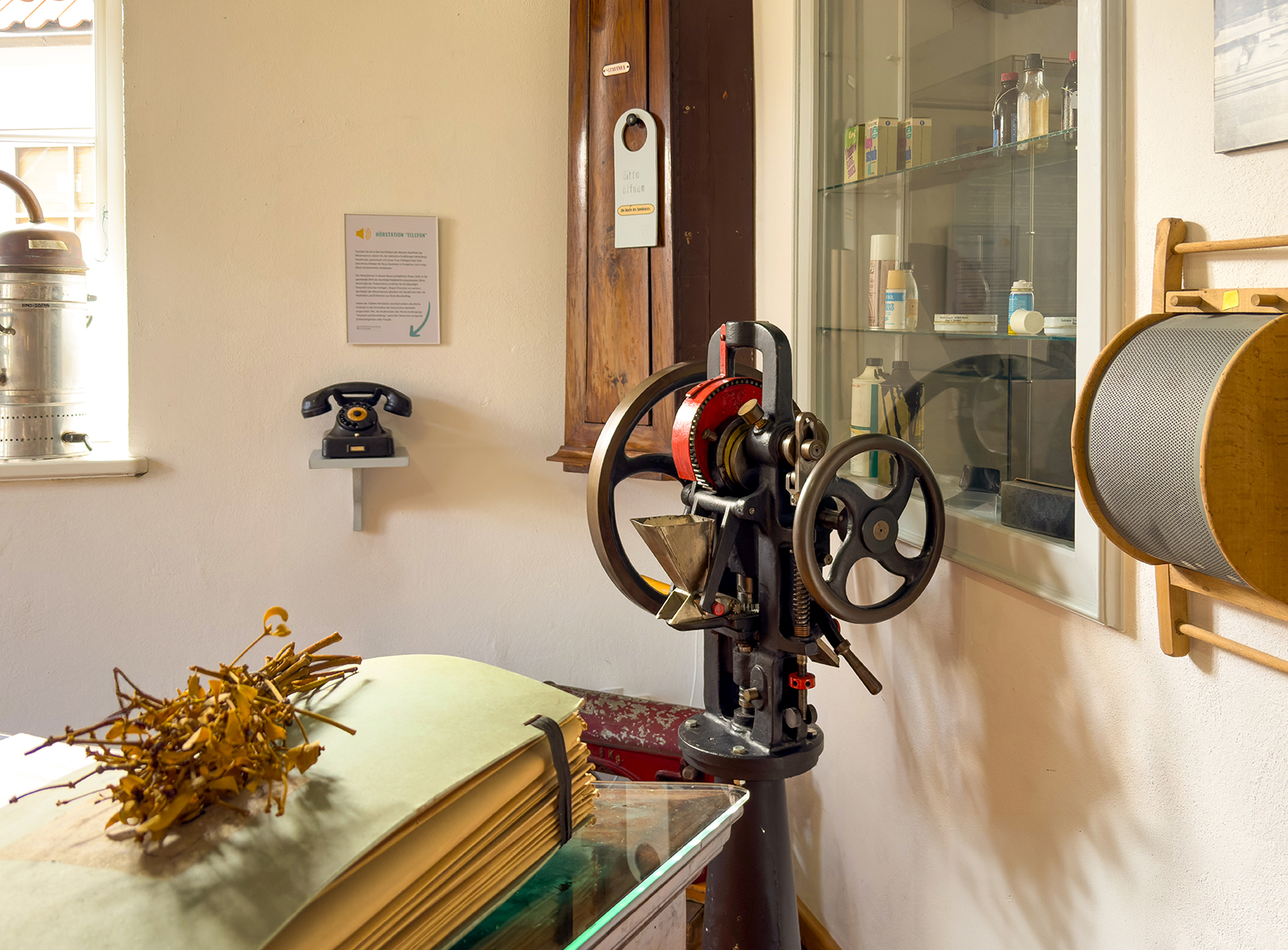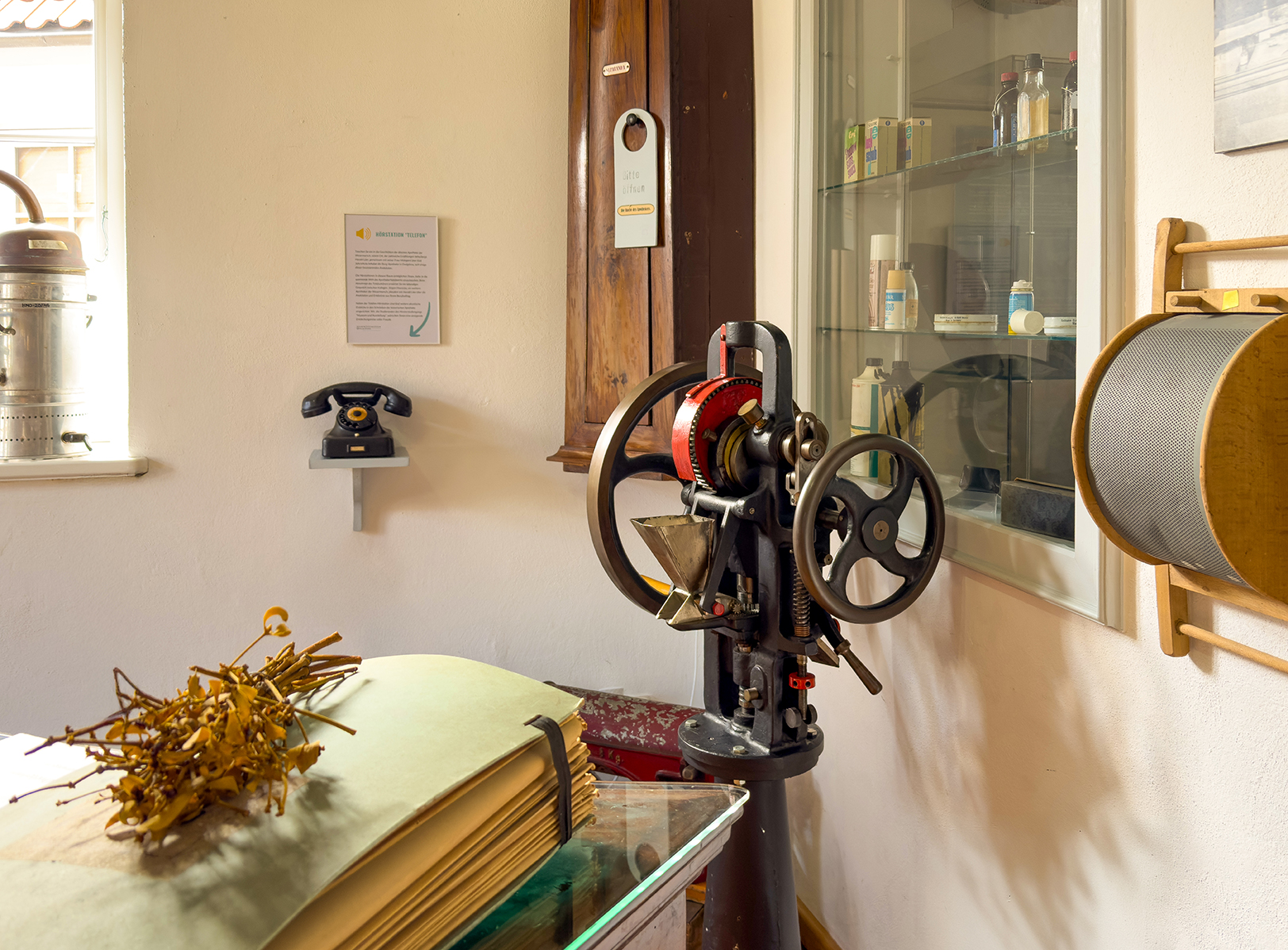
The Crafts Museum Ovelgönne is delighted to announce a remarkable donation: a historic eccentric tablet press from the early 20th century now enriches the pharmacy corner of our permanent exhibition.
With a vigorous turn of the crank, powders were once transformed into hand-pressed tablets. The imposing cast-iron construction is not only a technical masterpiece but also a fascinating window into the history of pharmacy, long before tablets were produced industrially in their millions.
How the Machine Works
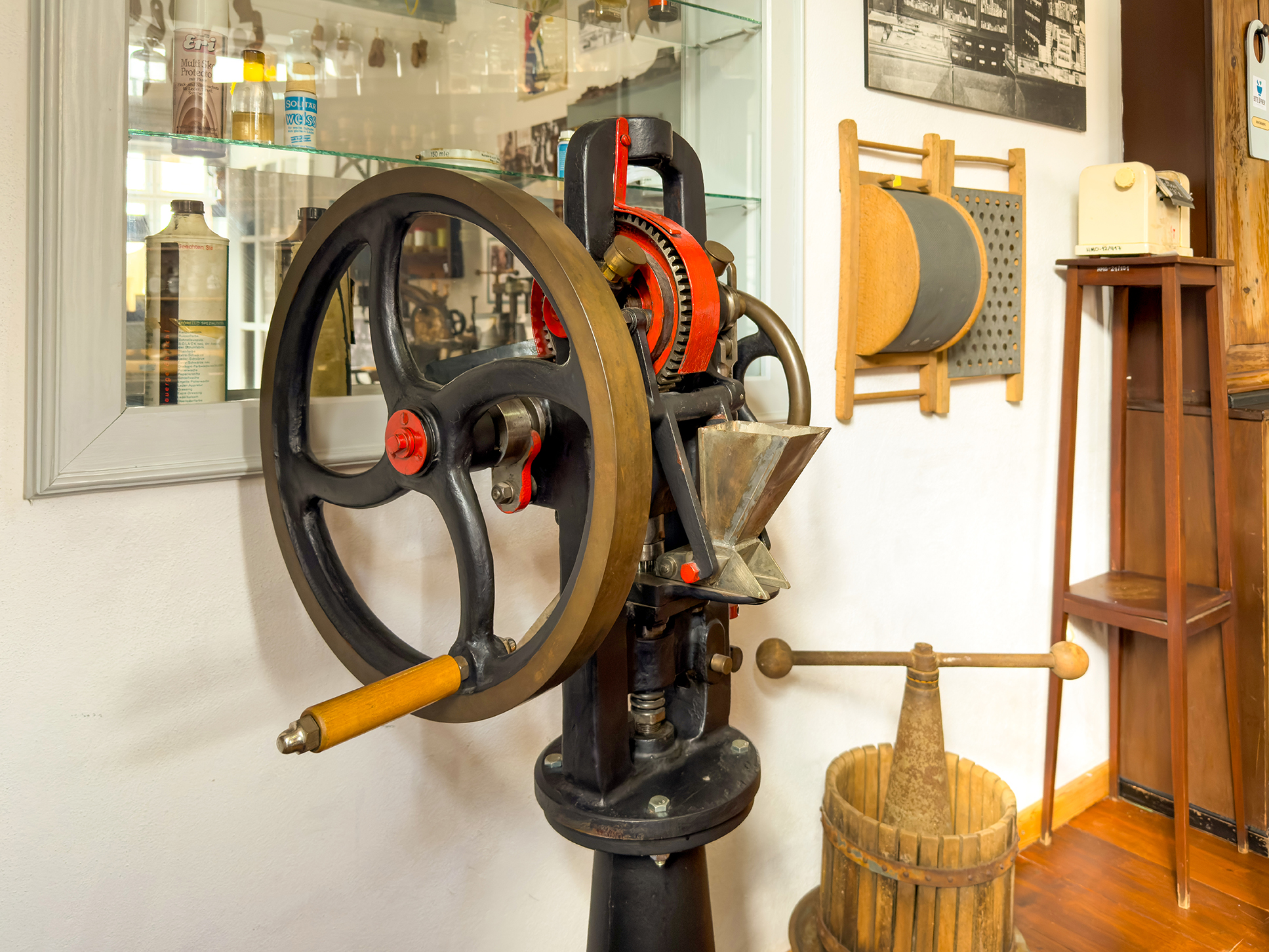
The press operates on the eccentric principle: the rotational motion of the large side flywheel is transferred via a shaft to an eccentric disc, which converts it into a steady up-and-down movement. A stamp drives downward and compresses the powder in the die into a solid tablet. On the next upstroke, the finished tablet is ejected and pushed into a collection tray.
Experienced operators could produce several hundred to as many as 1,000 tablets per hour with machines like this. That was a genuine revolution compared to the laborious hand-rolling of pills.
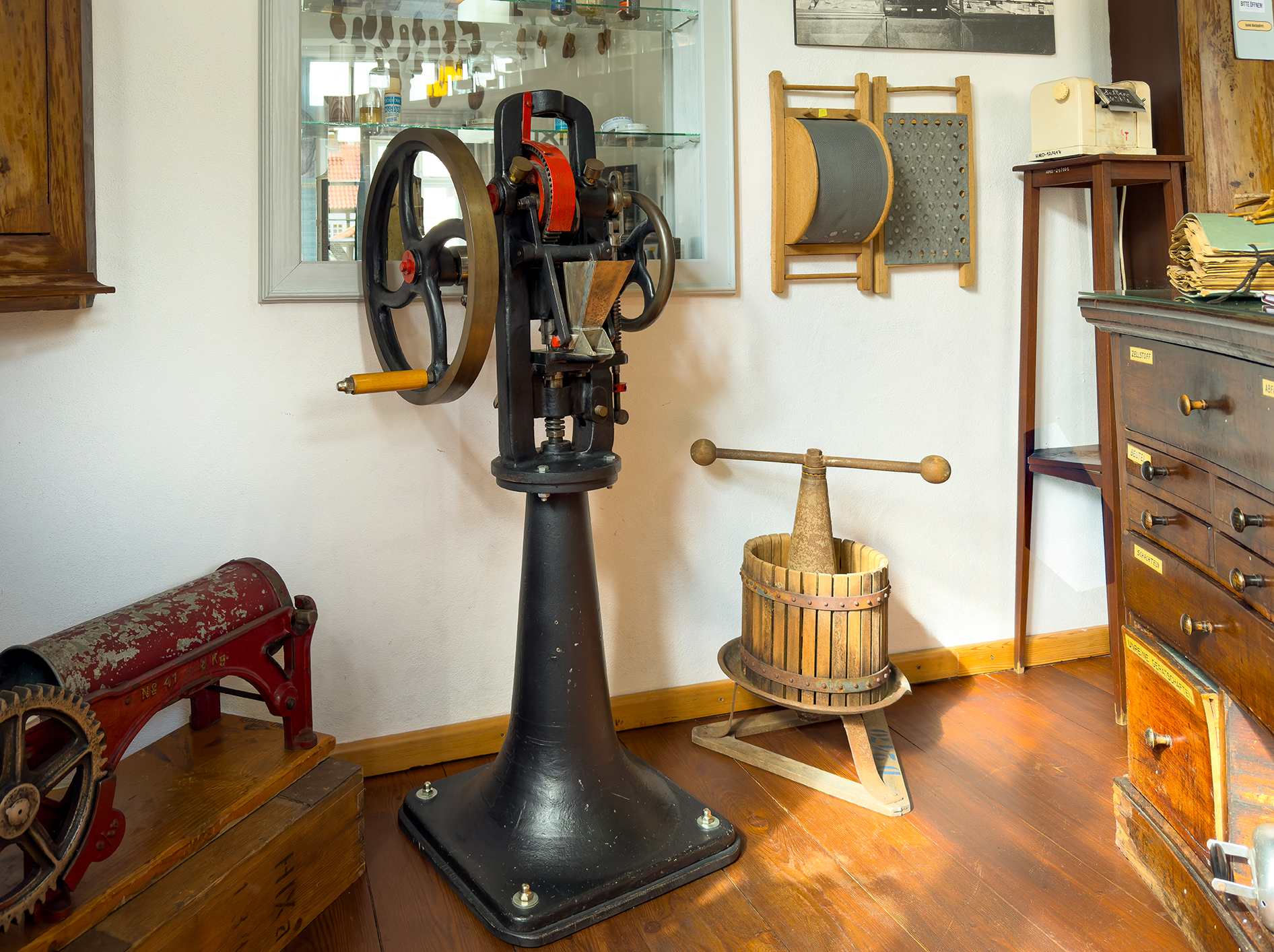
Pharmacists as Craftspeople
Before the introduction of such apparatus, medicines in pharmacies were dispensed mostly as powders, hand-rolled pills or liquid tinctures. With compact presses like this one it became possible for the first time to produce tablets of consistent weight, exact dosage and uniform firmness directly in the pharmacy dispensary. The pharmacy trade was at that time far more than simply filling pre-made preparations.
Technical Specifications
| Feature | Details |
|---|---|
| Object name | Eccentric tablet press (single-punch press) |
| Type | Mechanical impact press for manual operation |
| Dating | c. 1890 to 1930 (Late Imperial / Weimar Republic period) |
| Application | Pharmacy laboratories, small pharmaceutical businesses |
| Materials | Cast iron (body), steel (mechanism), brass (filling funnel), wood (crank handle) |
| Drive | Manual hand operation via side flywheel |